
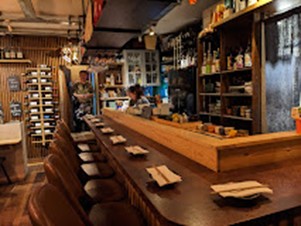
In a Soho alleyway close to the massage parlors and other establishments of ill repute and hidden behind an inconspicuous door sits a small rustic Japanese sushi (and more) Michelin-starred restaurant.
Jugemu is its name, sounding not unlike the game or film Jumangi, except here characters and forms appear in the shape and taste of fish and vegetables carved from the knife of its master chef.
While writing this feature I looked up the meaning of Jugemu, because my Japanese language skills are decent after forty years but not that fluent. What I found made me chuckle. Jūgenmu (寿限無) literally translates to limitless life or endless longevity.
The name comes from a classic rakugo comedy tale where a father, hoping to bless his newborn with every bit of good luck possible, asks a priest for the most auspicious name. The priest lists off a series of fortunate phrases, and the overenthusiastic father uses all of them. The result? An absurdly long name that begins with “Jūgenmu Jūgenmu…” and goes on and on. The joke lies in how no one can ever finish saying it—an exaggerated take on people’s obsession with good fortune and superstition.
You need Jūgenmu not only to enter this sacred space but to stay and be allowed back for several reasons.
One. Respect. If you do not respect the owner and his method of serving, you probably do not belong here.
Two. Gratitude. For good luck to last, one needs gratitude in life. This, of course, applies to every morsel, bite, toothsome flavor, and presentation.
Three. Acceptance. The menu changes yet is limited. Accept what is and do not attempt to correct, replace, add, or remove what is being served. If you cannot find what you like then you ought to try a non-Japanese restaurant.
I went with a friend who was enthusiastic about treating me to his “favorite Japanese restaurant in London”. Having lived in Japan and being called a “tsu” by my friends in Tokyo (a gourmand), I was up for the challenge. I originate from New York City where there are 20 Michelin-starred Japanese restaurants. So I’m not a stranger to excellent Japanese cuisine or omakase. Los Angeles has even more at 29.
We were the first customers of the evening (but not for long) and sat at the bar to eat and chat with the chef. We started with a bottle of sake and had to eat rather quickly so as not to miss the theatrical performance we booked for 7:30. We did not have limitless time but a limitless appetite which we had to save for another time. Chef was accommodating when we told him our plans. I cannot recall the entirety of what we ate because one delicious bite melted into the next, but from what I recall, the starter was agetofu, done perfectly, crispy yet glutinous with a speckle of green onion. This was followed by nigiri of horse mackerel, savory, umami-forward, with a mild oceanic tang. Several small dishes and cups of sake later, we had to scoot. The entire experience was divine.
Jugemu opens at 6pm – 10:30pm every day except Sunday. Located at: 3 Winnett St, London W1D 6JY, UK.
Phone: +44 20 7734 0518.
Reservations required as seating is limited. https://www.instagram.com/jugemu.uk/