
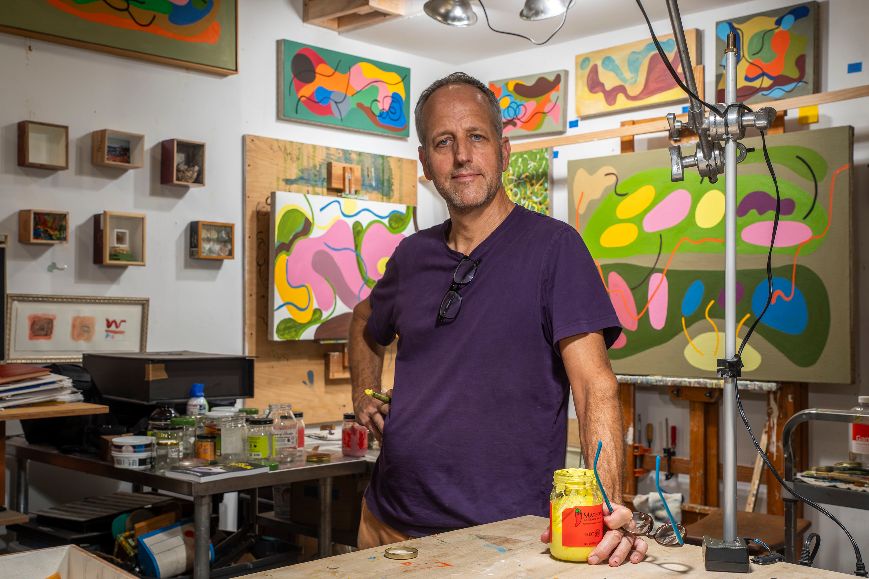
In his Austin home studio, amidst canvases alive with sweeping ovals, kidney shapes, and Rorschach-like kaleidoscopic nature designs, Charles Heppner moves between paintings, photography, and sculptural boxes. The room hums with visual energy: cardinals, branches, butterflies flash across his computer screen, while seas and gardens emerge in photographs and bursts of color appear in framed oil paintings in amorphous organic shapes. Nature, movement, and color are his constants.
It’s hard to miss the sense of motion in Heppner’s work. ‘Movement,’ he says, ‘is everywhere — it’s the dance of time, the dance of a universe, the dance of stars.’ His paintings may not depict figures, but their forms pulse like living things, resonating with the same organic rhythms one finds in gardens or forests. These are more than just abstractions.
Heppner’s journey into art did not follow a linear path. Born into a large Chicago family, he pursued both mathematics and art from an early age. Swimming and bike racing (in France) were part of his youth, as was an unshakable pull toward creative expression.
‘Art was always part of me,’ he recalls, even during his years as a derivatives trader in Chicago. The trading floor paid the bills, but the studio fed his soul.
Encouraged by a mentor, Father Vorwald, Heppner left Chicago’s Gold Coast for East Pilsen, a neighborhood that welcomed artists into loft spaces. ‘I’d leave my trading job and go home to my studio,’ he says. ‘I’d listen, work, and just make.’ He studied figure drawing at the Drawing Workshop and later at the Hyde Park Arts Center, where he began exploring multiple mediums — painting, photography, and what would become one of his signatures ‘sanctum boxes.’
Nature is more than inspiration for Heppner — it is the origin point. ‘These paintings,’ he says, gesturing toward a series, ‘are called quantum color memory projections.’ The term speaks to his approach: quantum as the essence, color as visceral energy, memory as a place or moment that anchors the work. His relationship with color borders on synesthetic. ‘An electric yellow makes me vibrate and I want to be with it,’ he explains. ‘Evening primroses in my garden — that pink — that’s where it comes from. But when I’m painting, it’s the color itself that takes over.’
This connection extends to his ‘arboreal chords’ series, where compositions are tuned like musical instruments. ‘There’s a point where all the colors are in tune,’ he says. ‘When I feel a vibration of sound that’s connected, I know it’s done.’
Heppner’s philosophy of beauty is expansive. He cites Alan De Souza’s definition: ‘Beauty is a transaction between the stimulus that provokes the experience and the person who has the experience.’ For Heppner, this definition allows beauty to remain fluid, personal, and alive. ‘We are part of nature,’ he says. ‘We are everything we experience.’
His guiding definition of art comes from philosopher Susanne Langer: ‘Art is the creation of forms symbolic of human feelings.’ This resonates deeply with his ‘memory projections,’ works that transform experiences of place, time, and emotion into layered visual forms.
Gardening has become central to Heppner’s life and art. His next exhibition will focus on his own gardens, from sunflowers to standing cypress. ‘When you’re in with them,’ he says, ‘there’s a definition of beauty that comes alive.’ His photography, too, often begins outdoors — from kaleidoscopic images of London plane trees in Brooklyn to the delicate blueish eggshells of yellow-crowned night herons collected from his Austin neighborhood and displayed in what he calls a ‘sanctum box.’
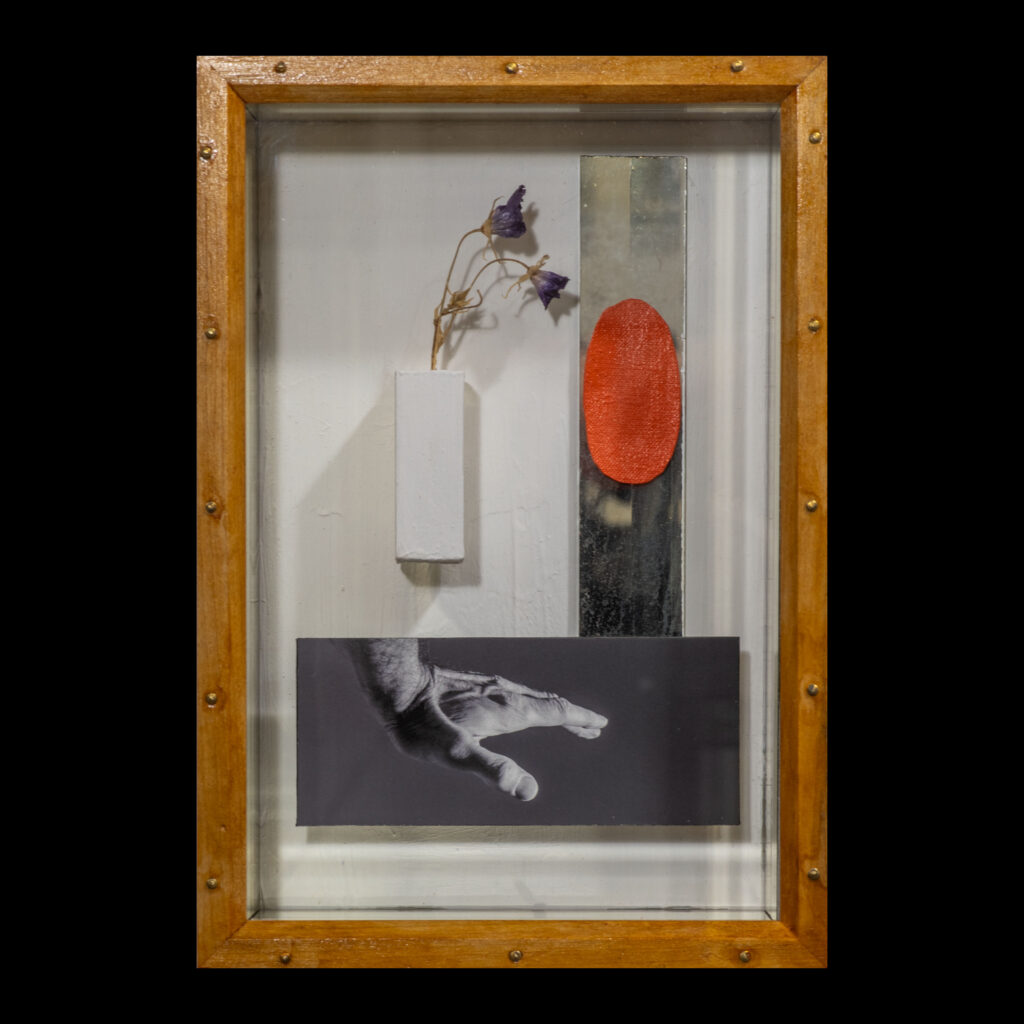
The sanctum boxes — intricate assemblages begun over fifteen years ago — are personal meditations on self-actualization. One, titled ‘Life is for Real,’ contains fragile eggshells from the herons. ‘Life is fragile,’ he says simply. These works merge the tactile and the symbolic, embodying his belief that materials carry stories as vivid as images.
Ten years ago in 2015, Heppner moved to Austin, where he quit trading and a day job for good, and transitioned to a full-time homemaker to his two children from his second wife; he also partially raised his first daughter from his first marriage, and artist. His home studio ‘about ten times larger than what I had in Brooklyn’, became a laboratory for experimenting with color theory, influenced in part by conversations with UT Professor, artist and color theorist Luann Stovall. Here, the Texas light, the gardens, and the seasonal changes inform his palette and subject matter.
Heppner resists being pinned down to a single medium or style. Whether through paint, photograph, or sanctum box, a devotion to nature, a responsiveness to color, and a belief in art as a living exchange between object and observer unify his works. ‘I don’t want to be pinned down,’ he says. ‘I want to keep following the work wherever it leads.’
In his studio, shapes twist and unfurl, colors hum, and the boundaries between memory and present blur. Heppner views art as less about a still image and more about a space for viewers to enter the rhythm – a rhythm like a star dance.
Learn more about Charles Heppner at www.charlesheppner.com, Instagram @charles_heppner, FB @Charles Heppner – Artist or visit his profile on www.artsy.com to explore his artwork, bio, and show history.
Heppner’s work is available through the Davis Gallery and Framing in Austin. Contact them at davisgalleryaustin.com for more information.
Photo credit: Charles Heppner