
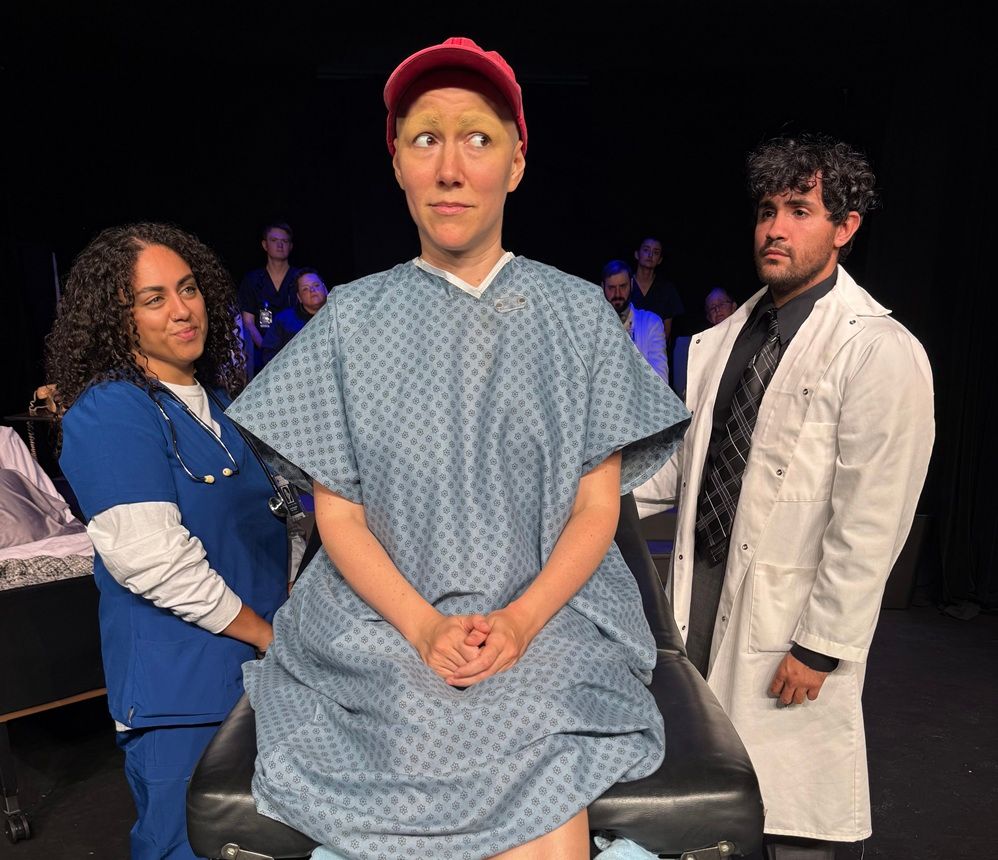
This one act 90 minute show could’ve gone on for another hour. I was glued to my seat. As a scribe, words are my life. And tools. A scholar wrote this play. One of the many lines that gutted me: “The acquisition of vocabulary was her only defense.”
That—*that*—was me as a child. And later, as a teenager. I used words like knives. Vocabulary was my weapon, my armor, my only damn shield in a family of chaos, disappointment, and broken silences. I could—yes—cut my sworn enemies: family members—with a single, slicing sentence. Like Vivian Bearing in *W;T*, the main character, I did it with precision.
So when I sat in the small theatre space at City Theatre Austin, watching this Pulitzer Prize–winning play unfold—Margaret Edson’s *W;T*, directed by newcomer Adam Adolfo—I wasn’t just watching theatre. I was revisiting memories I thought I’d filed away. I was in the room again with my mother as she lay helplessly. The silences. The sterile air. The unbearable truths.
Taylor Flanagan, playing Vivian Bearing, is astonishing. Her portrayal navigates the razor’s edge between devastating self-awareness and dry academic detachment. She speaks in first person from her hospital bed with a mix of wit, rage, and critique. At one point, she says of her own ovarian cancer: “The Fairy Queen this is not!” Brilliant. That’s what I call out-of-body textual criticism—humor cracking through horror. The line I put to paper in my book of great quotes by others.
The doctors and medical staff—played by Andrew Soltis, Stephanie Salama, Julien Hemmendinger, Alan Brent, Dawn Azbill-Smith, Adriana Fontanez, Reed Syzdek, and CB Feller—were disturbingly accurate. Sophomoric. Entitled. And sadly true. I wanted to pull my hair out watching them fumble forward and condescend, because I’ve lived through their real-world counterparts. The technocrats of empathy. The procedural automatons. The ones who speak to clipboards and machines instead of to my mother, who had Stage IV lung cancer. This production didn’t exaggerate. It exposed. And that’s the most frustrating part. Because patients in America are treated like automatons, to be rid of.
W;T is not a comfortable play. It’s not meant to be. But it’s an *essential* one.
It dares to ask what dignity looks like in a system that quantifies survival and forgets suffering. It asks what it means to live a life of the mind when the body is failing. And it asks it with poetry—John Donne’s sonnets threading through each scene like a ghost chorus. “No man is an island…” hangs in the air like a hymn, even as Bearing, the once-unshakeable professor, unravels. Interesting side note. Segments of the audience’s eyes glazed over as they listened without comprehension to the soliloquy of refined English.
Adam Adolfo’s direction is sharp and unfussy, letting the language do the work. It’s his Austin directing debut, and he brings a refined clarity to a difficult story. The cast is grounded, human, and heartbreakingly honest. Taylor Flanagan, a multidisciplinary theatre-maker and recent finalist in the Del Shores Foundation Writers Search, gives a performance that will echo long after the final scene.
*W;T* by Margaret Edson is a Pulitzer Prize–winning play that explores the emotional and intellectual unraveling of Vivian Bearing, a poetry professor diagnosed with terminal ovarian cancer. First produced in 1995, it premiered in New York in 1998 and has since won many awards, including the Drama Desk, Outer Critics Circle, and Drama Critics Circle awards.
City Theatre Austin’s production of *W;T* runs July 25 – August 10 and features a “Wall of Hope” where audience members may leave messages in memory or honor of loved ones who have battled cancer. Messages can also be submitted on the City Theatre Facebook page. Currently in its 19th season, the company is a not-for-profit arts organization with support from the Austin Creative Alliance and the City of Austin’s Cultural Arts Division.
If you’ve ever sat beside a hospital bed when sorrow left one impotent. If you’ve ever weaponized your own vocabulary because it was the only power you had—’go see this play.’
Bring tissues. Bring your dictionary. And bring your willingness to be undone.
512-470-1100