
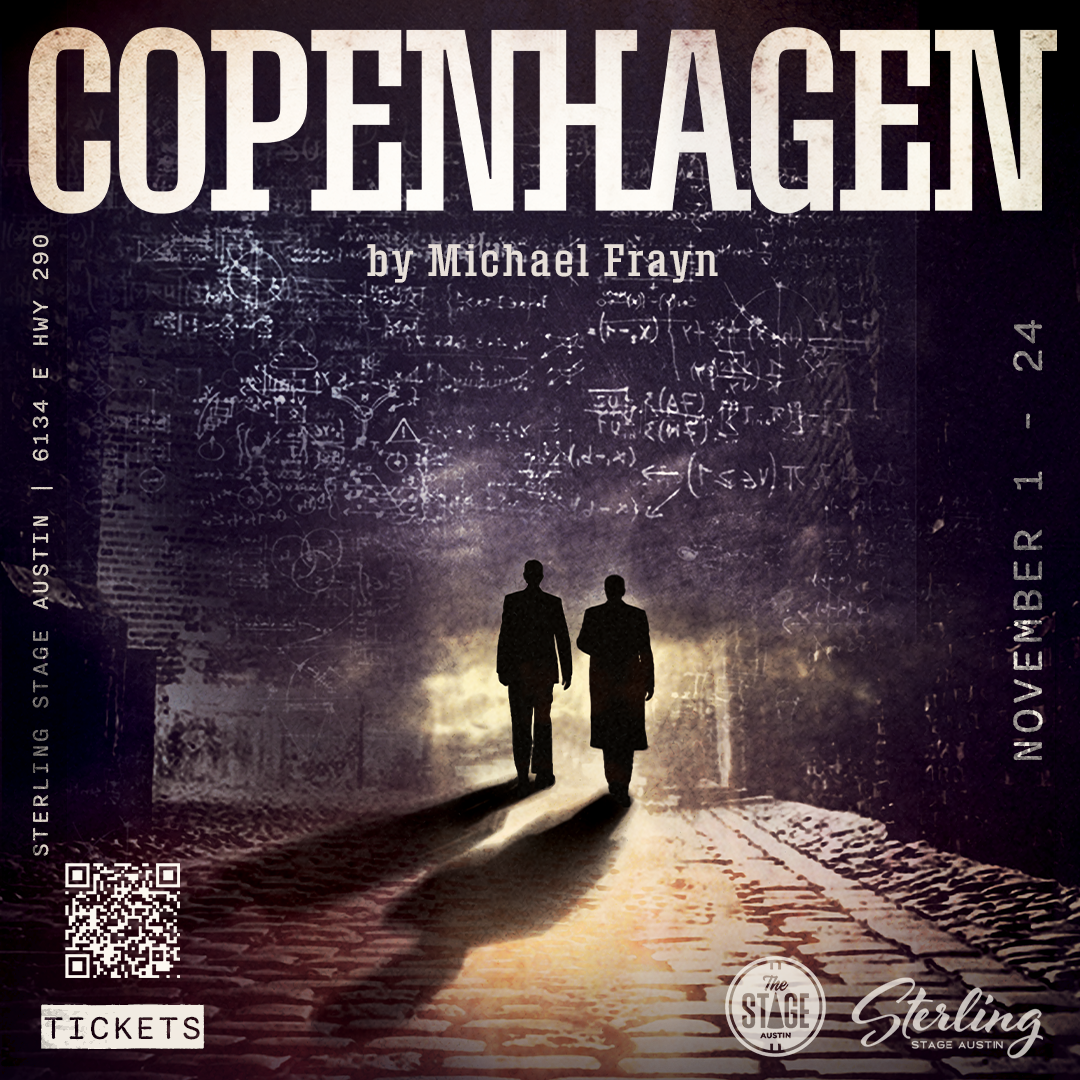
Michael Frayn, a British playwright whose production of Copenhagen first appeared in 1998 and the Tony Award for Best Play winner, delves into the layered uncertainties of history, morality, and quantum mechanics through a speculative account of an authentic 1941 encounter between physicists Niels Bohr and Werner Heisenberg. This fateful meeting, set in Nazi-occupied Denmark, remains historically enigmatic; the play dramatizes it as a tense philosophical exchange laden with scientific and ethical ambiguity. Frayn, aptly summarizing the themes of his work, once said, “History is not what happens when it happens, but what seems to people to have happened when they look back upon it.” This perspective infuses Copenhagen, urging audiences to reflect on how the present molds interpretations of the past.
Heisenberg, a German physicist and former protégé of Bohr, visits his mentor amid the German atomic research program’s advancements. Their exchange probes the profound ethical responsibilities of scientists working under oppressive regimes and contending with technologies of unprecedented destructive power. Heisenberg’s visit raises the play’s central question: did he seek Bohr’s guidance or approval, or perhaps to seek his complicity? As they debate, each character wrestles with his role in the burgeoning nuclear arms race, underscored by the complex uncertainty principle Heisenberg himself formulated in quantum mechanics—the idea that one cannot simultaneously know a particle’s position and momentum. Frayn uses this scientific uncertainty as a metaphor for the moral ambiguities both men face in grappling with the consequences of their work.
About the Physicists
Bohr, an innovator in atomic theory and an eventual collaborator on the Manhattan Project, became integral to nuclear physics development in the United States during World War II. Bohr escaped Nazi-occupied Denmark (he was half-Jewish and, like his colleagues Einstein, Lise Meitner, Otto Frisch, and others, fled Germany). Bohr joined the American efforts to develop atomic weapons. With scientific clarity and a commitment to transparency, he argued for international cooperation to mitigate the arms race he feared would follow nuclear discovery. His advocacy even led him to propose to President Roosevelt and Prime Minister Churchill that the Soviet Union should be involved in the postwar atomic framework to balance the devastating power with ethical responsibility.
Heisenberg, on the other hand, led the German nuclear research project—known as the Uranium Club—throughout the war, navigating his role as both a scientist and a citizen under the Nazi regime. While some historians believe Heisenberg made errors in calculating the uranium critical mass needed for a bomb, potentially delaying its development, others speculate he may have intentionally miscalculated to prevent a fully realized German atomic weapon. Copenhagen gives depth to Heisenberg’s motivations, weaving a story where political allegiance, scientific rigor, and moral apprehension converge in a profoundly ambiguous ethical landscape.
The play frames these reflections through conversations broken by Margrethe, Bohr’s wife, who symbolizes a voice of moral skepticism. Her perspective adds a practical counterpoint to the scientific abstraction, questioning Heisenberg and Bohr’s intentions and implications, challenging their reconciliations of past actions with the looming specter of their potential consequences. As Margrethe cautions, “Absolution for sins past is not the same as sins yet to be committed,” prompting the audience to ponder Heisenberg’s true intentions and the broader ethical quandaries surrounding scientific discovery.
Austin Production
In Austin’s production, directed by seasoned theater professional Karen Sneed, Michael Stuart as Bohr, Scot Friedman as Heisenberg, and Meredith O’Brien as Margrethe performed on a minimalist set with only three chairs in a round stage arrangement. This simplicity heightened the intellectual and emotional rigor of the production, with each actor navigating the text’s scientific complexity and moral nuances without missing a beat. Running over two hours and forty-five minutes, the cast sustained the play’s intense intellectual engagement, grounding Copenhagen’s demanding script in a challenging and thought-provoking performance, offering the audience a powerful exploration of history, memory, and the ethical dimensions of scientific progress.
STEM students and people interested in 20th-century history shouldn’t miss this riveting show.
Tickets: https://tickets.atxtheatre.org/events/copenhagen
Price: General admission tickets $25, Students/Seniors $20
Date: Until November 24, 2024
Place: Sterling Stage Austin, located at 6134 E US 290 Service Rd Austin, TX 78752
Time: From 7:30 pm, Sunday matinees at 2:30 pm
Learn more about The Stage Austin at www.thestageaustin.com
[editorial note by Dr Cunningham: For those who want to read about the real story of Bohr and the institute in Copenhagen, this 2020 book is essential: The Copenhagen Network by Alexei Kojevikov. Published by Springer.]