In the College of Fine Arts at UT Austin, the School of Design and Creative Technologies (SDCT) sponsored Lauren Lee McCarthy, one of several artists in the Creatives on Campus series. McCarthy performed solo, her thought-provoking show Surrogate as part of Fusebox, an international alternative performing arts festival,
Founded in 2005 by a group of artists, Fusebox Festival is now in its 17th year.
Renowned and up-and-coming artists worldwide perform for less than a week in Austin. Held at sites and venues across the city: intimate galleries, theaters, and clubs, to large-scale projects springing to life in parks, under bridges, and across entire neighborhoods.
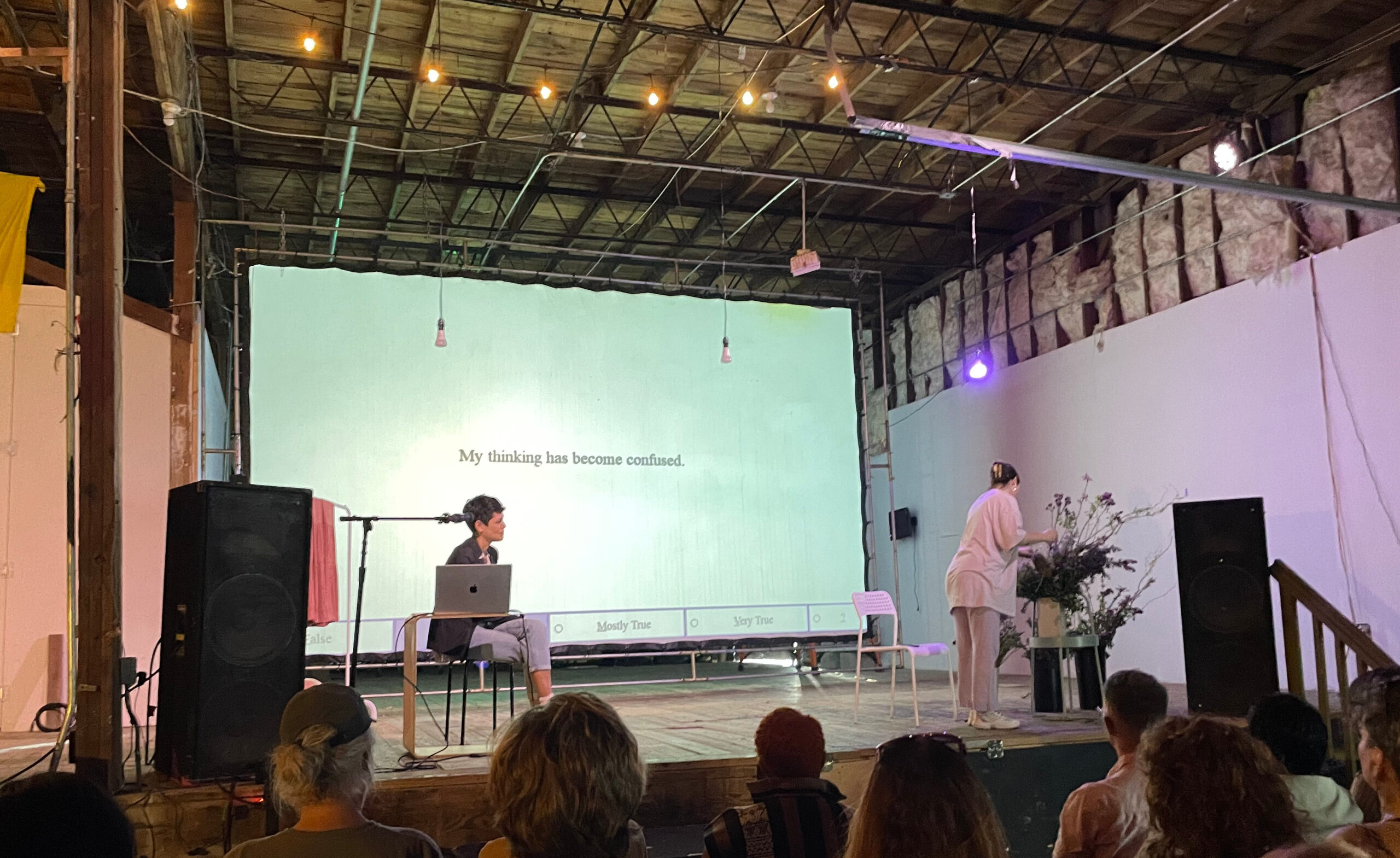
Held at the Museum of Human Achievement, Surrogate explored the psychology of living in a world of surveillance, high-tech algorithms, human connection, and the meaning of birthing another human being.
The show began with a screen of questions spoken aloud, questions the artist asked herself. At the bottom of the screen were checkboxes, like in a survey, actual, false, very good, bad, etc., and a voice spoke the repetitive line so you could faintly detect it.
Another woman onstage was creating a flower arrangement and cutting branches as Lauren pressed the keys of her keyboard.
Once the woman was finished, the fascinating and spooky real-life experiment began with Lauren offering her body, mind, and, who knows, perhaps her soul to random strangers she met online to be part of her “art.” Lauren explained,
The Surrogate project began with a 40-week performance where I’d serve as a gestational surrogate for a parent with an app to monitor and control me 24/7. The parent would have complete control over the body in utero.
At some point during the video footage, Lauren asked the audience for questions, of which there were many, but only a few brave souls raised their hands to ask in public. Here’s a sampling:
- Are you a sado-machicist?
- Did you allow these strangers to control you every day?
- Why did you try to get pregnant as a surrogate?
- Did you get pregnant, or was this just a show?
- What did your partner think of this?
As the artist and audience become immersed in the surrogate pregnancy, we discover that Lauren did not carry a baby at all. She learned what it would feel like to be a surrogate.
“And how did it feel?”
“I wasn’t sure if I wanted to birth a baby, and this art piece allowed me to explore my ambivalence about it and my ambiguous feelings about motherhood, surrogate birthing, and natural childbirth.”
The artist allowed our desire to perform this remote-control surrogacy as far as possible through an intense process of working with doctors, psychologists, fertility specialists, surrogates, doulas, midwives, and geneticists. It involved designing the Surrogate app, searching sperm donor databases, completing psychological evaluations and health exams, freezing embryos, talking with family, and ongoing correspondence with each other.
“Upon reaching the difficult moment where the medical-industrial complex shut down the surrogacy, I expanded the work into a series of short films, performances, and installations that tell the story of what happened.”
The medical establishment, in its hypocrisy, instills a rigorous testing procedure to determine whether a surrogate is “fit” to become one. Yet, the same applications to mothers who give birth naturally or via IVF are not adhered to. This dilemma poses many questions about the institutions that control women’s bodies. Does it also question the basic concept of who is fit to be a mother?
Lauren adds, “This deeply personal work offers my body as a physical, emotional, and conceptual surrogate for understanding reproduction and technology’s role. Becoming a remote control surrogate serves as a metaphor for the control we may soon hold through genetic engineering processes, as well as the direct infringement on our bodily autonomy enacted by the legislation of reproductive rights worldwide.”