
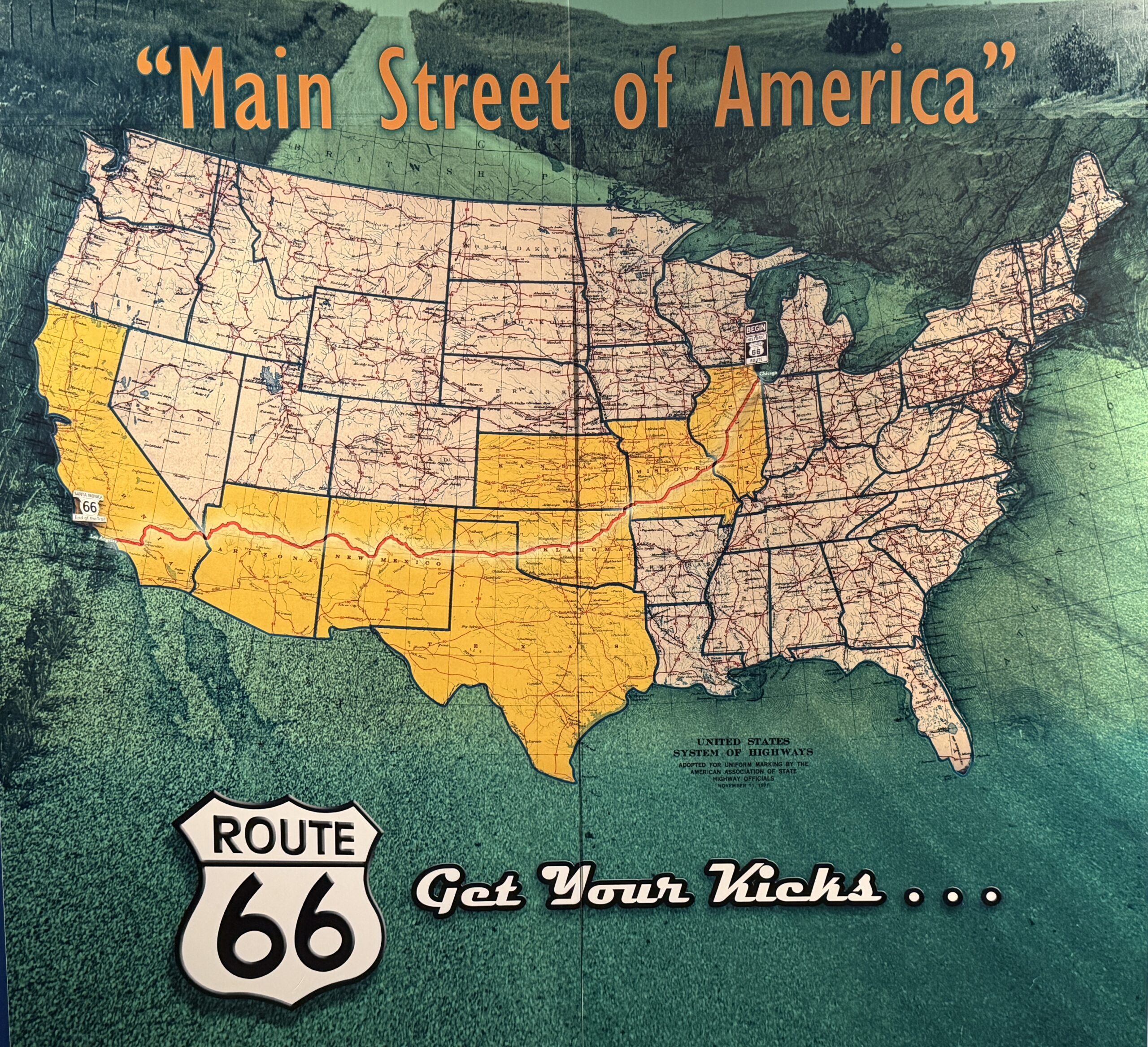
There are several museums along Route 66, stretching from Chicago to Santa Monica, but my favourite is in Clinton, Oklahoma.
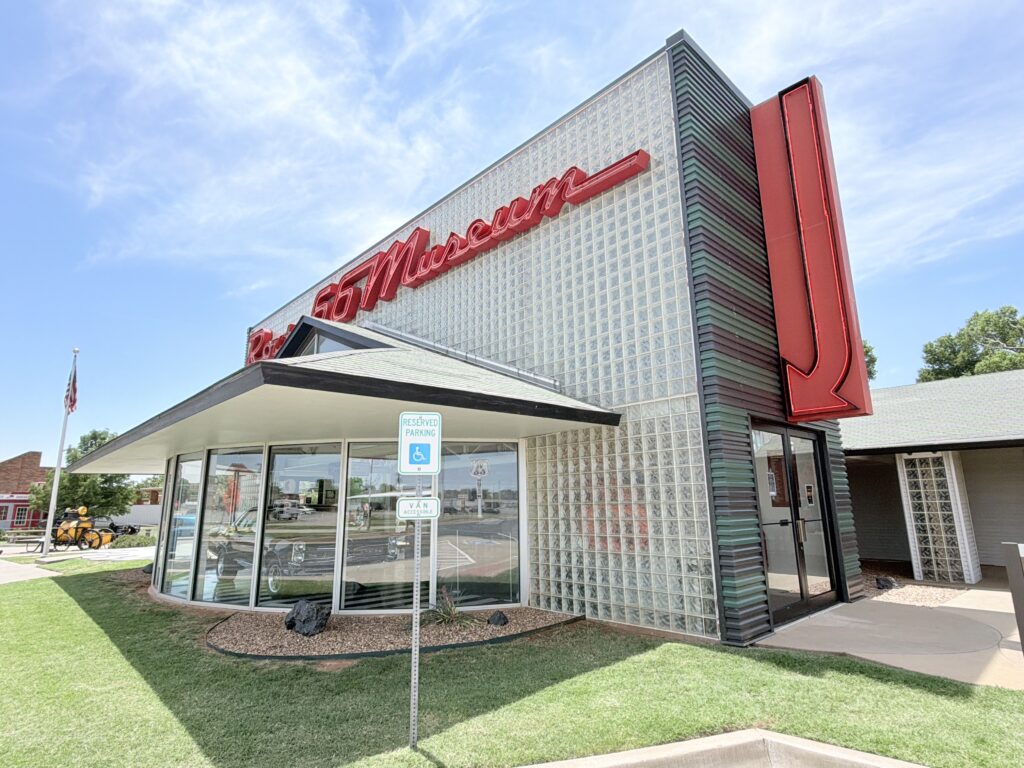
The Oklahoma Route 66 Museum opened 23 Sept. 1995, and was the first such museum dedicated to the history of Route 66, which celebrates its 100 birthday this year. I visited Clinton earlier this month. The museum, which was renovated in 2012, is a division of the Oklahoma Historical Society. The museum was revitalised earlier this year with the appointment of Cory Cart as the new Director.
It is fitting for Oklahoma to have the star attraction. The state has more drivable miles of Route 66 than any other state, boasting over 400 miles (of the original 432 miles) of the original and maintained alignments. The highway was decommissioned in 1985, but some 85% of the entire Route 66 is still drivable: the total length is 2,448 miles. The lead photo, which I took at the Oklahoma Route 66 Museum, gives a sense of the scale involved.
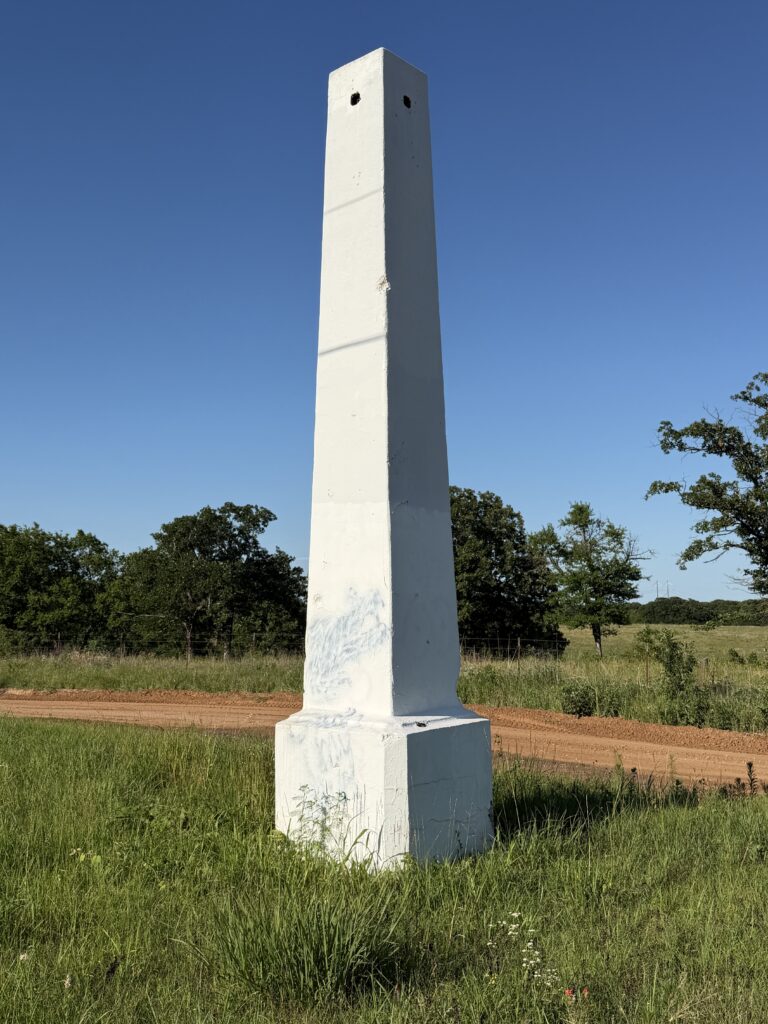
How, you might ask, did people drive before Route 66? The answer is the Ozark Trail, a system of mostly dirt roads, some of which were privately maintained, from 1913-1925. It ran from St. Louis, Missouri, thru Oklahoma, to El Paso, Texas. It was originally marked by 21 concrete obelisks, but only 7 remain.
While in Oklahoma, don’t miss the one near Stroud: of the 7, it’s the only one close to R66. It’s 1.5 miles along the old dirt road, and is not marked on the R66 road. You can find it 2 hours east of Clinton, partway between Oklahoma City and Tulsa. Travelling east, if you pass the big red sign “Ozark Hill RV Park”, turn around: you just missed the dirt road on the right! I suspect very few people see this important monument to America’s road system. (photo at end of my story)
There are important things to see on the outside of the building before entering. To the left of the entrance is an “End of Project marker” used in 1931 during the construction of R66. It was originally placed nearby in Neptune Park. To the right is a 6-ft-high monument commemorating the Will Rogers Highway. It reads in part: “Will Rogers and Route 66 are symbols of American optimism. They have become internationally known, sharing Oklahoma with the world.”
The expansive lobby, complete with a 1967 Pontiac, also hosts an array of R66 items, including R66-themed clothing I saw nowhere else along the trip I took in June from Amarillo to Chicago. I nabbed a colourful hoodie with a motorcycle on the back.
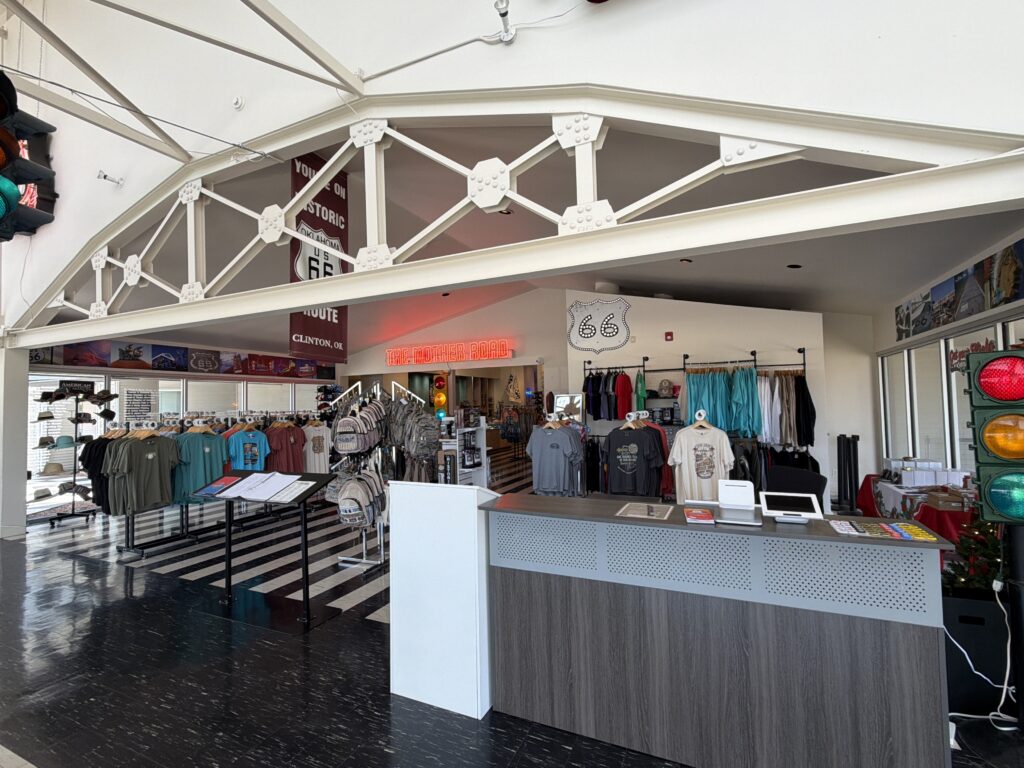
The fun begins at a double door with the words “Get Your Kicks on Route 66” emblazoned above. A staff member will be pleased to take your photo here. Upon entering you will soon see the map I used as the lead photo in this article, and a semi-circular wall covered in colourful images from every state along the route.
Looking down in a display case, don’t miss an artifact labelled “Portion of curb”. It is a section of Portland concrete from here in Clinton. “On portions of Route 66 travellers can still locate the road by the colour of the road surface.” The real nitty-gritty of Route 66!
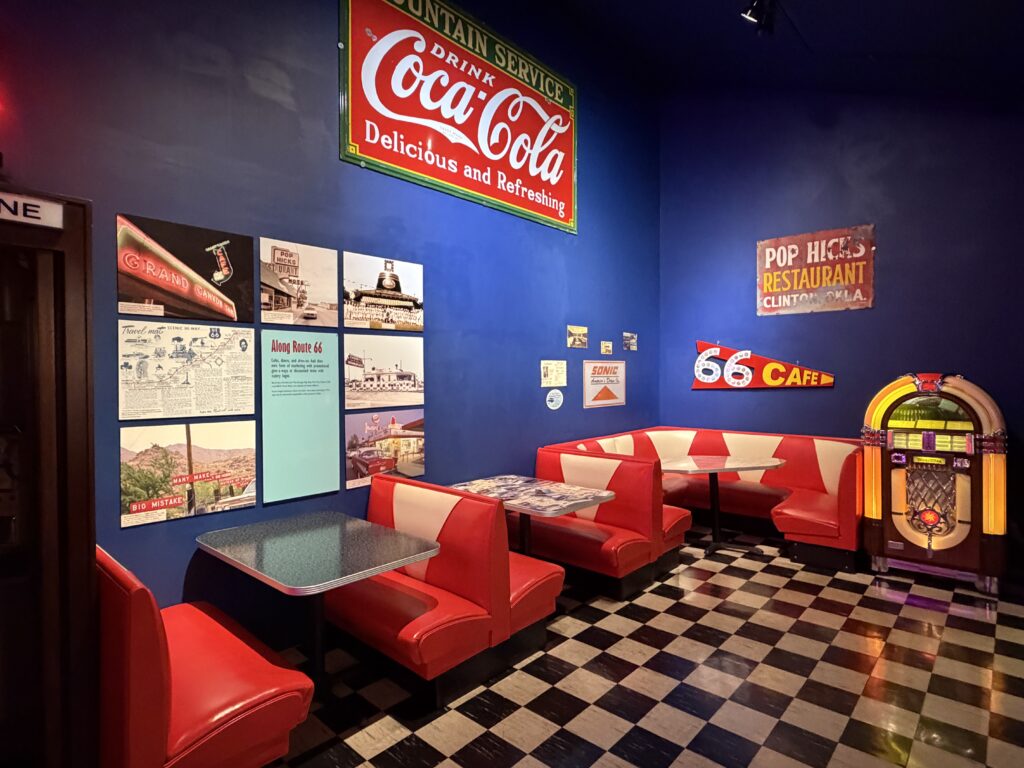
A curio cabinet here is filled with small collectables, including a small glass from Pop Hicks Café in Clinton. Pop Hicks was a legendary Route 66 diner here. Established in 1936, it grew from a tiny 3-booth diner into a famous national landmark. Sadly, the building was completely destroyed by fire in 1999 and was never rebuilt. But here you can see a reconstruction of a R66 café, complete with an original sign from Pop Hicks restaurant on the wall. Don’t miss the 1950s photo from Oklahoma City: Cherry’s Hamburger stand with 11 young ladies dressed as carhops posing out front.
The Father of R66 is Cyrus Avery (1871-1963), and a photo of him is surrounded by early road construction images, some pre-dating R66. A diorama with real construction equipment is nearby.
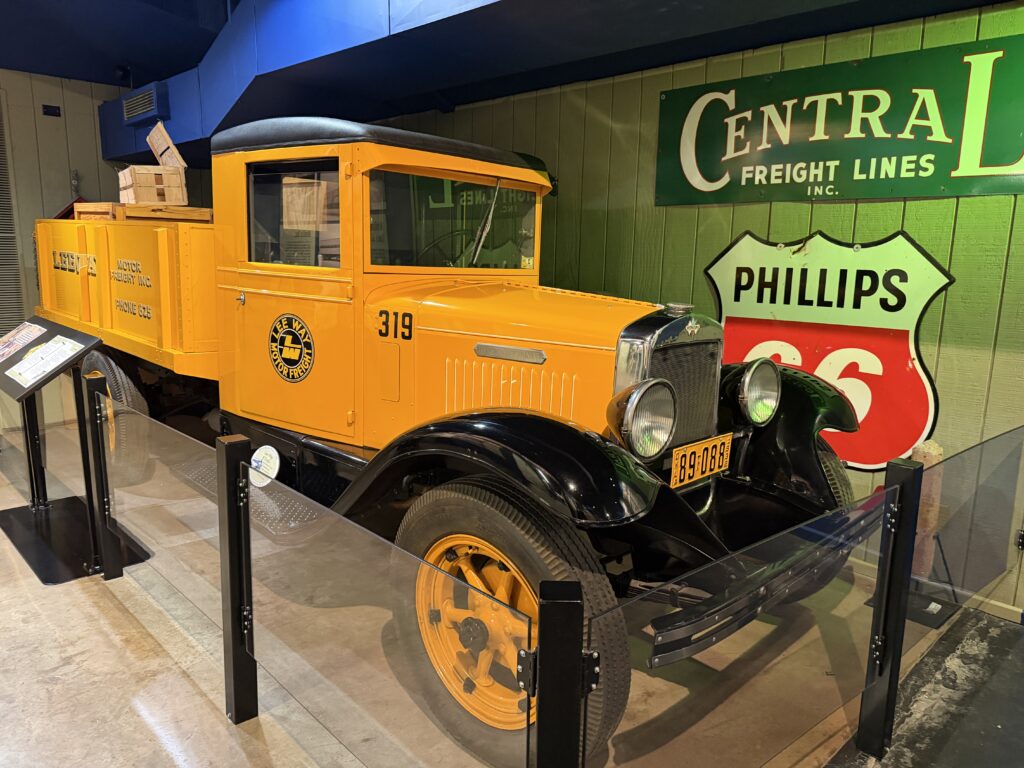
On display is an early Lee Way truck, the most frequently-seen motor carrier on R66 for 30 years. The first delivery service established by R.W. Whit Lee was right here in Clinton. That was with a horse and buggy, soon to be replaced by a Model T Ford. In 1925 he established a bus line from Clinton to El Reno, 58 miles away. In 1934 he began running 3 trucks to Amarillo and by the time he sold the company to Pepsi in 1976, his company employed 3,595 people, many of whom drove large Lee Way Motor Freight trucks from Missouri and Oklahoma thru Texas and New Mexico.
This is just a taste of the history beautifully displayed in the museum in Clinton. Make sure you see it on your Route 66 roadtrip. And remember that the big day is actually November 11: that is the day in 1926 Route 66 it was officially commissioned.
also read my Route66 article on the car museum:
All photos by C. Cunningham. Copyright SunNewsAustin.
https://www.okhistory.org/sites/route66
Address: 2229 W Gary Blvd, Clinton, OK 73601
Below: The Ozark Trail obelisk
Subscribe to the excellent Route 66 magazine: www.routemagazine.us